
Two multi-billionaires. Two empires. A three-month window. Choose your fighter 😎
Optimus VS Prometheus. Which robotic company will dominate the world next 10 years? Bets are being placed right now. Robotics + Physical AI Edition · May 2026 · By WeTheAtlas Team & Djoann Fal


While everyone debated the OpenAI / Anthropic compute deal, Elon Musk dissolved xAI as an independent company and rebranded it as SpaceXAI, the AI division of SpaceX.
SpaceX now operates across five layers: Launch, Connectivity, Compute, Applications, and Orbital Infrastructure. Colossus 2, known as Macro-Hard, is targeting 1 gigawatt and 550,000 Blackwell GPUs. A third campus in Southaven, Mississippi pushes total capacity toward 2 gigawatts and over 1 million GPUs. Musk leased the older cluster to Anthropic and kept the Blackwell capacity for Grok-5 training. SpaceX is building what could be called “Elon Web Services,” and Anthropic is its first customer.
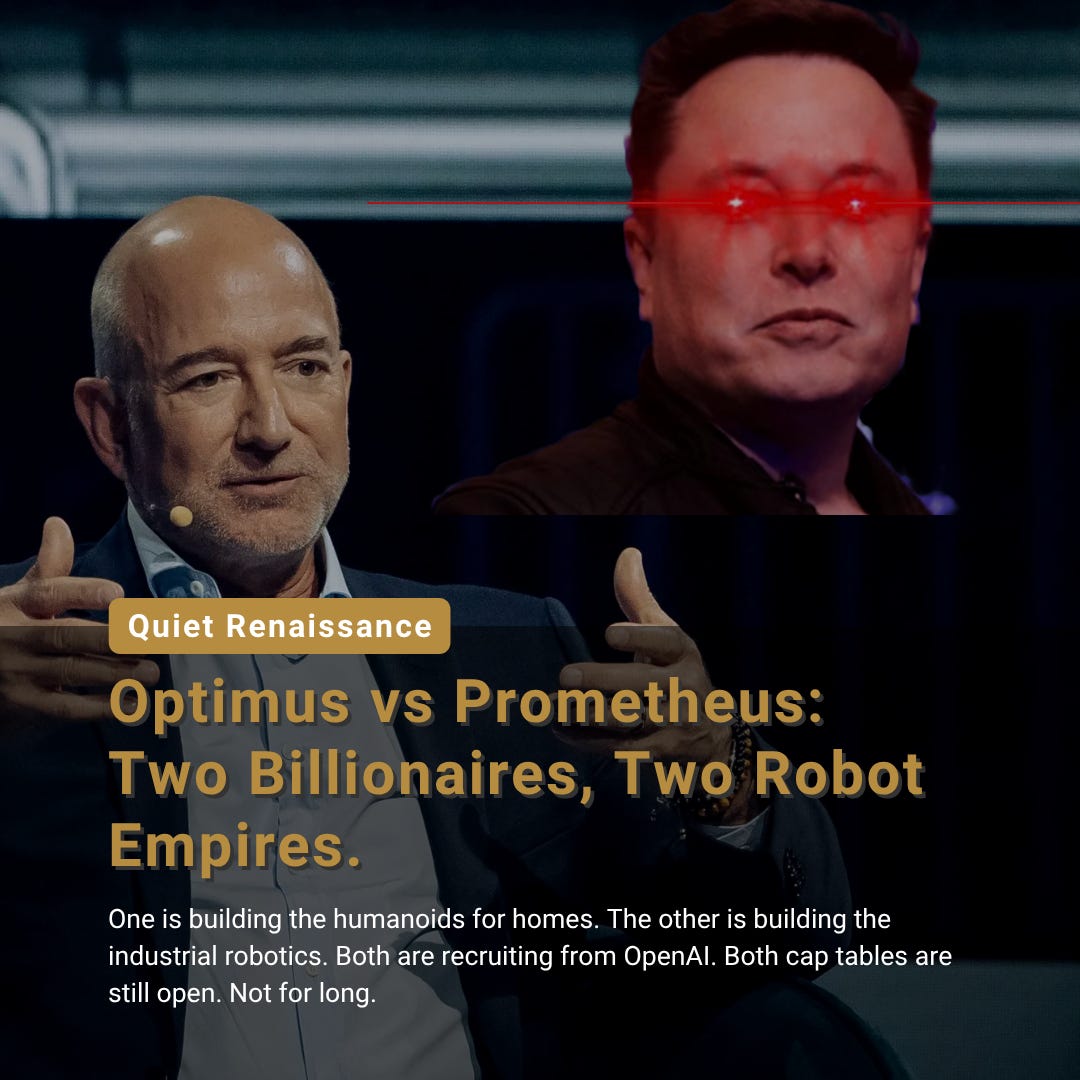
Meanwhile, Jeff Bezos raised $16 billion in six months for Prometheus, his Physical AI company targeting the $30 trillion manufacturing economy. Amazon’s 750,000 warehouse robots become training data. Blue Origin becomes the aerospace vertical. Kuiper becomes the connectivity layer. A reported $100 billion industrial holding company becomes the acquisition vehicle. The integrated stack no competitor can replicate.
This is not venture capital anymore. This is the construction of century-scale empires.
Musk is building the compute and orbital layer. Bezos is building the industrial AI layer. Both are recruiting from OpenAI, DeepMind, and NVIDIA. Both are deploying at scales that make traditional VC rounds look like seed checks.
And both have cap tables that are still open.
Foundation is raising $100 million at a $1 billion valuation, with $24 million in Pentagon contracts already secured. Figure AI, valued at $39 billion, is producing one humanoid robot every 90 minutes. GrayMatter Robotics just signed with the largest shipbuilder in the United States.
The window to co-invest alongside the category kings of Physical AI is measured in months, not years. Pre-IPO allocations are closing. Defense contracts are being awarded. Production lines are scaling.
By the time this is obvious, the cap tables will be closed.
The demo era is over. The deployment era has begun.
I. MACRO THESIS: The Biggest Labor Arbitrage in History
We are witnessing the early innings of a structural shift that makes the internet look incremental. For the first time in human history, general-purpose physical labor is becoming programmable. Not with specialized arms bolted to a factory floor, but with mobile, dexterous, AI-native machines that can load a dishwasher this week and breach an enemy site next week.
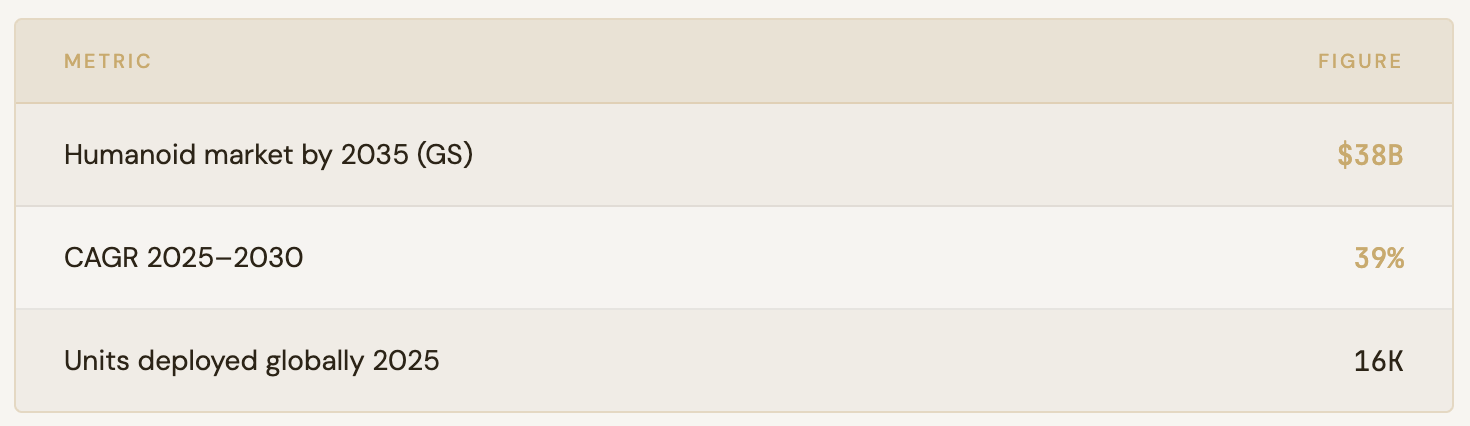
The catalyst is the convergence of three curves hitting their inflection points simultaneously: foundation model intelligence (robots that understand natural language), hardware cost collapse (a 40% drop in high-spec robot costs from 2022 to 2023 alone per Goldman Sachs), and structural labor scarcity that no policy can reverse.
Germany faces a projected shortfall of 7 million skilled workers by 2035. Japan’s working-age population has been shrinking for two decades. China’s manufacturing workforce peaked in 2017. These are not cyclical problems. They are demographic facts. Humanoid robots are not a luxury. They are a structural necessity.
II. THE DATA: Capital Is Concentrating, Fast
Global robotics funding surpassed $10.3 billion in 2025, the highest total since 2021. Capital is consolidating around scaled platforms with real commercial deployments. Late-stage humanoid platforms are absorbing the mega-rounds while early-stage capital flows to enabling software and domain-specific applications.
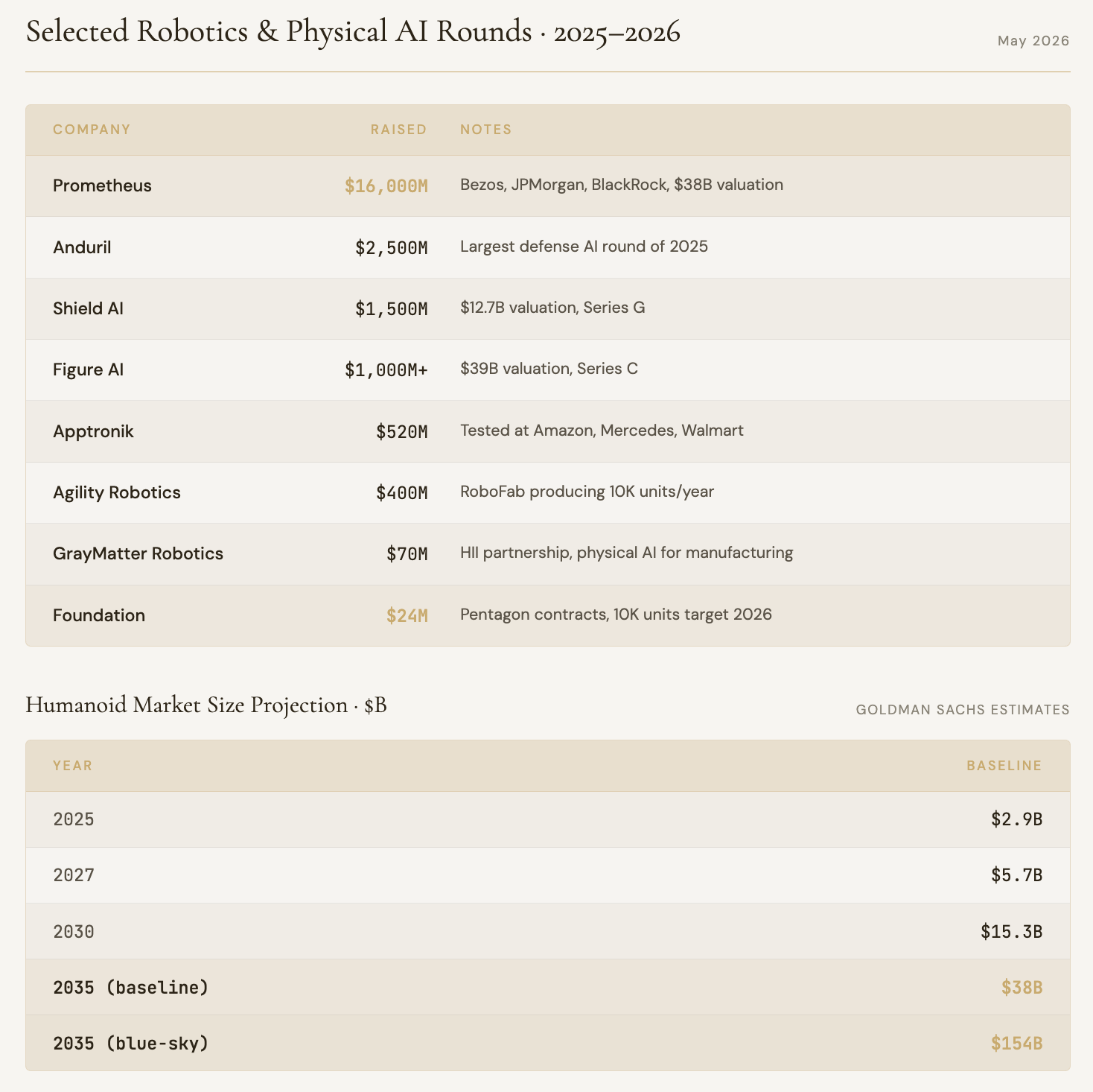
Note: Blue-sky ($154B) is a full-adoption outlier. Goldman Sachs $38B baseline assumes 40% hardware cost reduction and moderate enterprise adoption.
III. INVESTMENTS OF THE WEEK
Two deals define where Physical AI capital is flowing in 2026: one from a first-time founder with Pentagon contracts, the other from the architect of modern logistics making his third act.
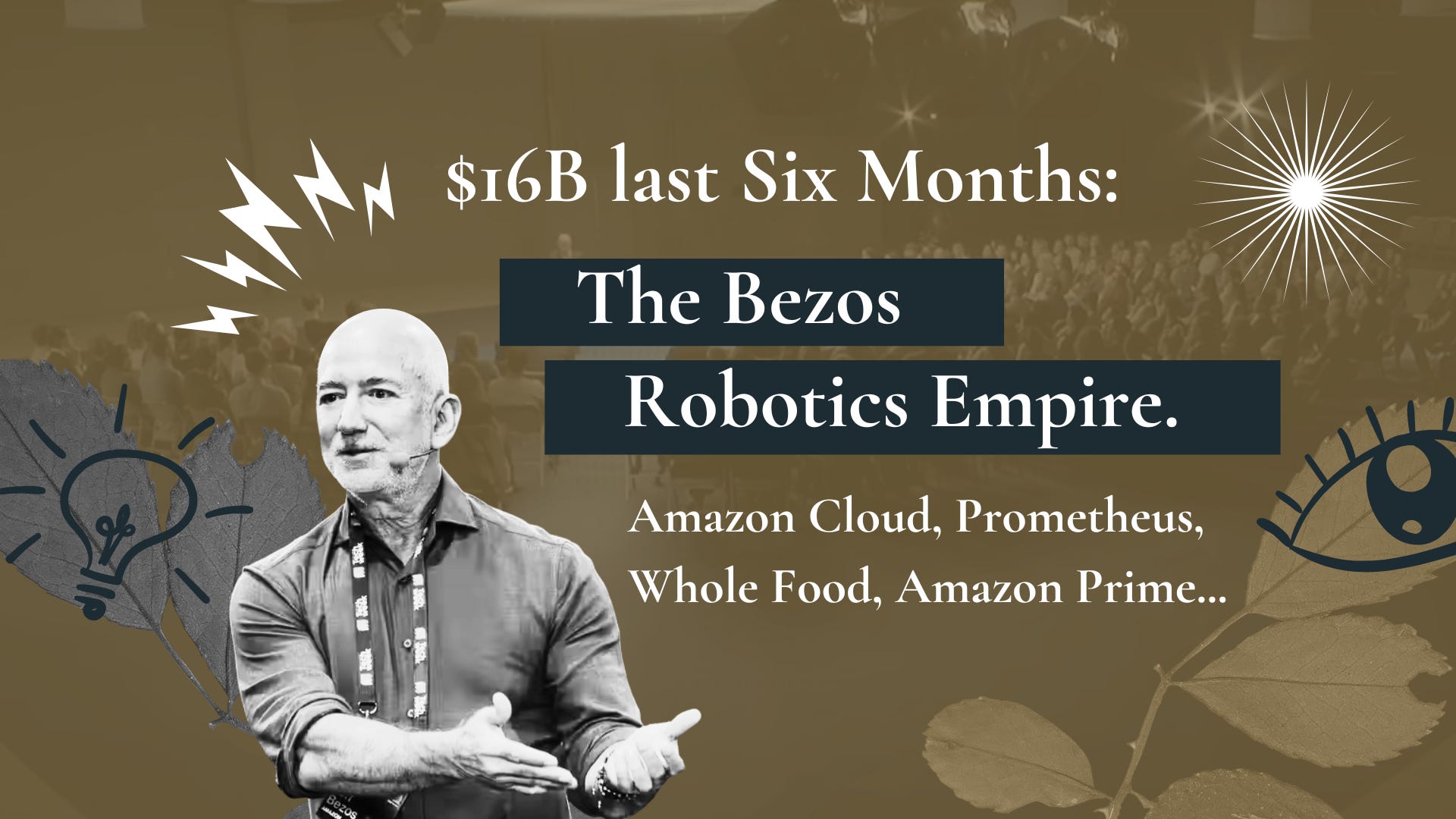
PROMETHEUS · Physical AI Infrastructure Layer
Stage: Growth Raised: $16B+ in under six months Valuation: $38B Investors: JPMorgan, BlackRock, DST Global, ARCH Venture Partners, Middle East and Singapore sovereign wealth funds, Jeff Bezos personally
Jeff Bezos built the logistics backbone of the digital economy. Now he is building the AI infrastructure layer for the physical world.
Prometheus launched in November 2025. Within six months: 120+ employees recruited from OpenAI, DeepMind, Meta, Microsoft, and NVIDIA. Offices in San Francisco, London, and Zurich. $16 billion raised across two rounds, among the fastest capital formation in startup history.
The thesis is vertical integration at Bezos scale:
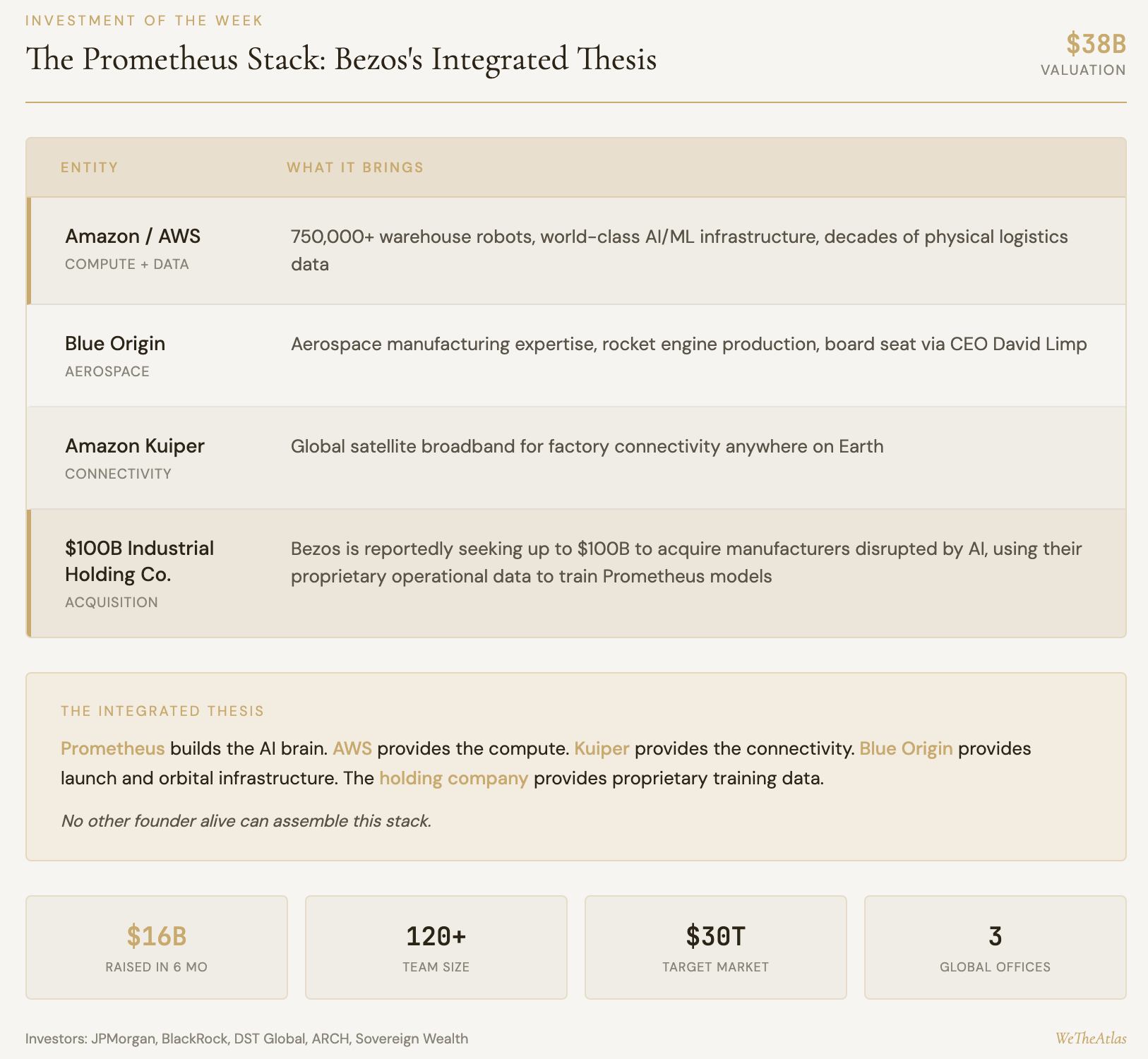
The integrated thesis: Prometheus builds the AI brain. AWS provides the compute. Kuiper provides the connectivity. Blue Origin provides launch and orbital infrastructure. The holding company provides proprietary training data.
“The physical world is the next frontier for AI, and no one is better positioned to own that frontier than the man who already built its logistics backbone.”
Why it matters: This is not a startup. This is infrastructure. The $30 trillion manufacturing economy has no AI layer. Bezos is building it.
Key risks: No disclosed revenue or shipped product. $38B valuation implies significant future expectations. Heavy reliance on Bezos’s continued involvement.
IV. FROM OUR STAGE: Foundation & GrayMatter Robotics
At the SF Climate Week Summit on April 22, we hosted founders from across the robotics and physical AI ecosystem aboard the USS Hornet. Two stood out.
Foundation presented their Phantom humanoid weeks before securing $24 million in Pentagon contracts.
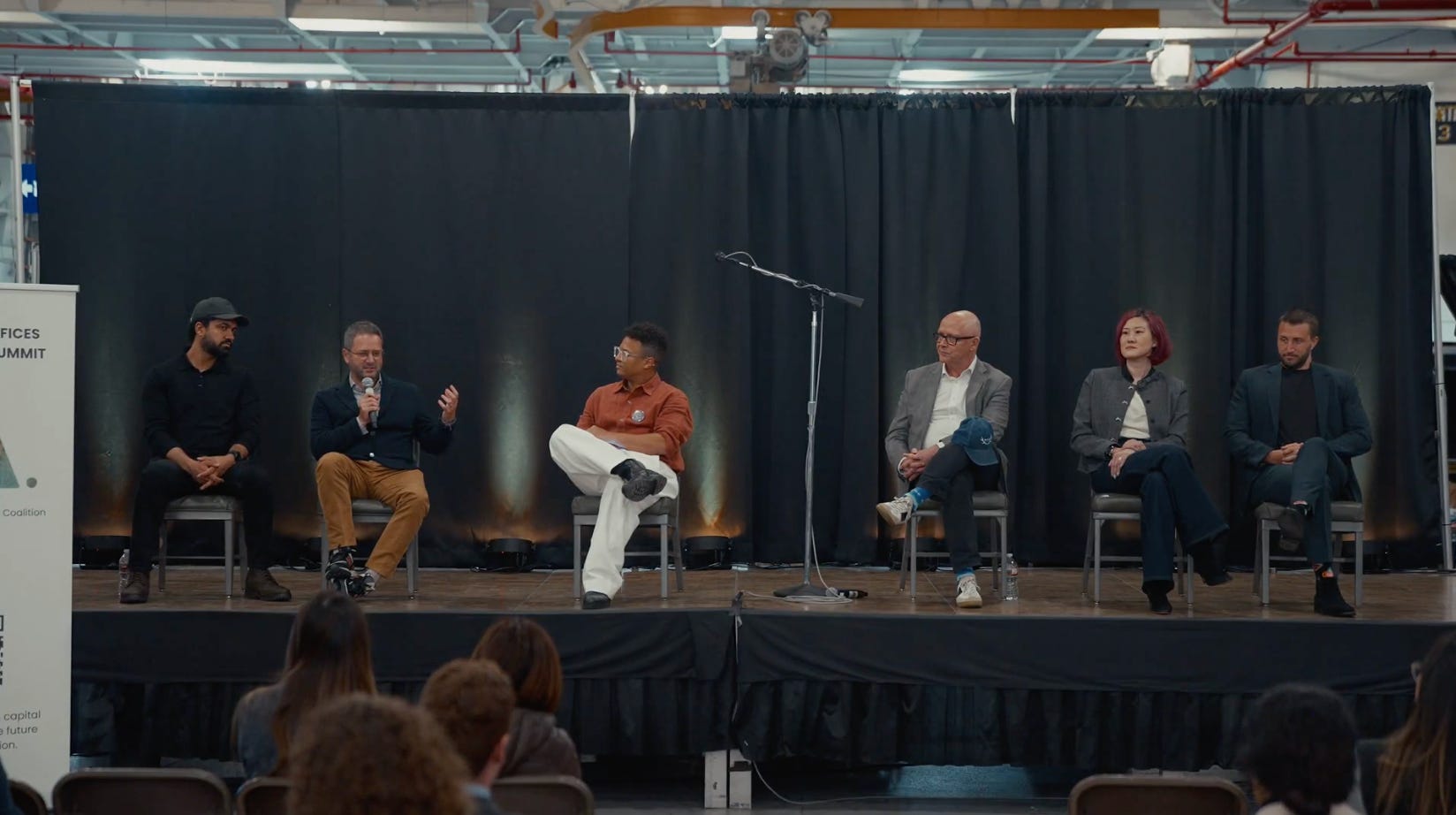
CEO Sankaet Pathak did not mince words:
“Over the course of the next 50 years, our labor workforce will shrink by 50%. Half of the people that are today building things, all the goods, services, factories, buildings, they will cease to exist in the labor market. If we don’t have industrial automation starting to replace what is going to become a quite significant deficit, we would have an implosion of the economy.”
He continued:
“The 5 trillion dollar number is actually quite conservative when you look at the existential crisis ahead of us. We have to do it now. The question is, is the technology ready for it? I think now the case is yes.”
Three weeks later, the Pentagon contracts closed. The company is now reportedly seeking $100 million at a $1 billion valuation.
GrayMatter Robotics showcased their physics-informed AI for manufacturing. Unlike humanoids designed for general tasks, GrayMatter’s robots self-program for surface treatment and finishing: sanding, polishing, coating, inspection. The pitch is simple. Traditional robots take weeks to program. GrayMatter’s machines do it in minutes.
The company has raised $70 million to date, including a $45 million Series B led by Wellington Management. In April 2026, they signed a partnership with HII, the largest shipbuilder in the United States, to deploy physical AI across sanding, grinding, and coating operations. HII’s throughput grew 14% last year with plans for another 15% in 2026.
These are the category kings quietly shaping vital industries. They do not need visibility. They need the right capital partners.
And they were on our stage before the headlines caught up.
V. COMPANIES TO WATCH
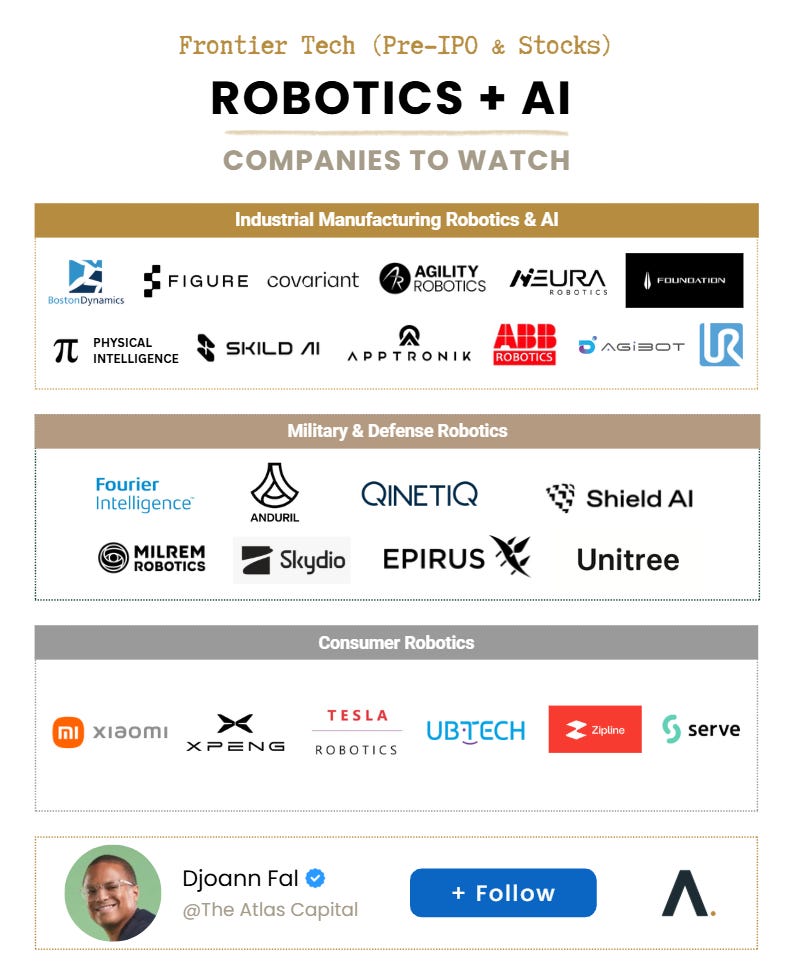
Figure AI · Pre-IPO Figure 03 launched October 2025. BotQ facility now producing one robot every 90 minutes, targeting 12,000 units annually. Helix AI handles household and commercial tasks without scene-specific training. Home alpha testing accelerated to late 2025. UPS pilots reported. IPO window: 2027-2028. $39B valuation · $1.9B total raised · Bezos, Gates, NVIDIA, OpenAI on cap table
Prometheus · Physical AI Infrastructure Bezos’s third act. AI models trained on real-world experimental data, robotic interactions, and engineering workflows. Purpose-built for aerospace, automotive, advanced manufacturing, and drug discovery. 120+ team from OpenAI, DeepMind, Meta. $38B valuation · $16B raised · JPMorgan, BlackRock, sovereign wealth
Foundation · Defense + Industrial Phantom MK-2 unveiled May 2026. $24M Pentagon contracts secured. SBIR Phase III designation allows follow-on work without new competition. Targeting 10,000 units in 2026, 50,000 by 2027. Seeking $100M at $1B valuation · Eric Trump as chief strategic adviser · In our dealflow
Apptronik · Pre-IPO Apollo humanoid tested at Amazon, Mercedes-Benz, Walmart, and Jabil. Partnership with NASA for space applications. General-purpose design targeting logistics, manufacturing, and retail. VC funding for humanoid robotics exploded 300% YoY. $520M raised · Feb 2026 · In our dealflow
GrayMatter Robotics · Manufacturing AI Physics-informed AI for surface treatment. Robots self-program in minutes, not weeks. Partnership with HII (largest US shipbuilder) announced April 2026. AFWERX Phase II contract secured January 2026. $70M raised · Wellington Management led Series B
Boston Dynamics · Public Atlas entering production. Hyundai targeting 30,000 units/year by 2028. Partnership with Google DeepMind integrates Gemini Robotics AI.
VI. THESIS: Three Structural Tailwinds, One Trade
Tailwind 1: Demographic inevitability. Labor shortages in manufacturing, logistics, and elder care are structural. Goldman Sachs projects humanoids could fill 4% of the U.S. manufacturing labor gap by 2030, and that estimate was made before the current pace of AI progress.
Tailwind 2: The cost curve is bending. Hardware costs dropped ~40% from 2022 to 2023, with analysts projecting 15-30% annual reductions ahead. At $30K-$150K per unit, the economics already pencil in high-risk environments. Robot-as-a-Service at ~$1,000/month removes the capex barrier entirely.
Tailwind 3: Foundation models are the unlock. GPT-4-class models mean robots can receive natural language instructions. NVIDIA’s Project GR00T provides a generalist AI backbone used by nearly every major humanoid company. The programmability moat is collapsing.
The investment question is no longer if but who. Capital is answering by concentrating in scaled platforms (Figure, Prometheus, Agility) while the asymmetric opportunity may lie in the enabling stack: actuator manufacturers, vision sensors, simulation software, and compute infrastructure (NVIDIA).
VII. CO-INVEST WITH US: PROJECT PROMETHEUS IS LIVE
Musk is building the compute layer. Bezos is building the industrial layer. Both are moving at scales that make traditional venture capital look quaint.
For the first time, we are opening access to co-invest alongside us in one of these category-defining deals.
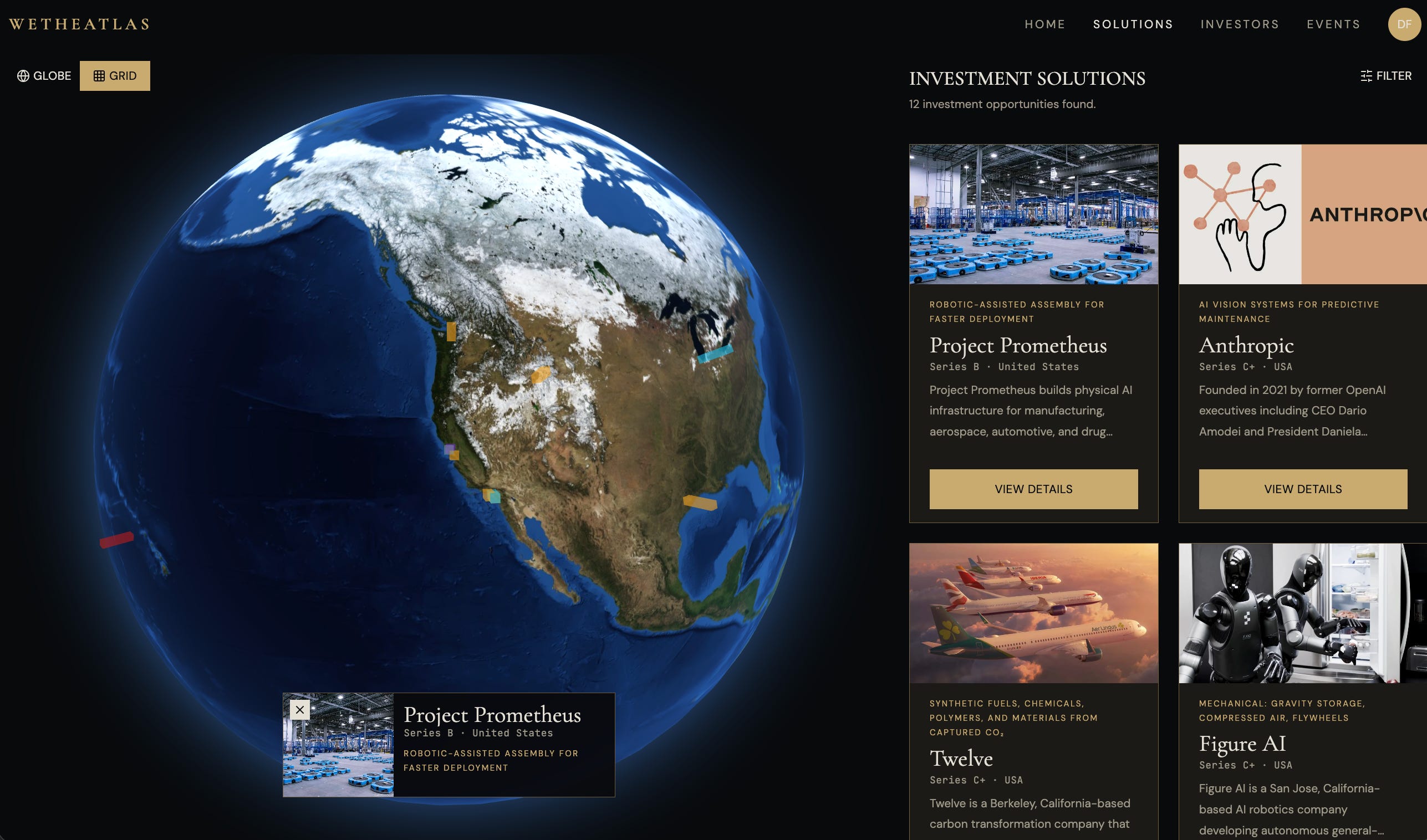
Project Prometheus is now live on the WeTheAtlas platform.
The allocation window is 10 days. After that, access closes.
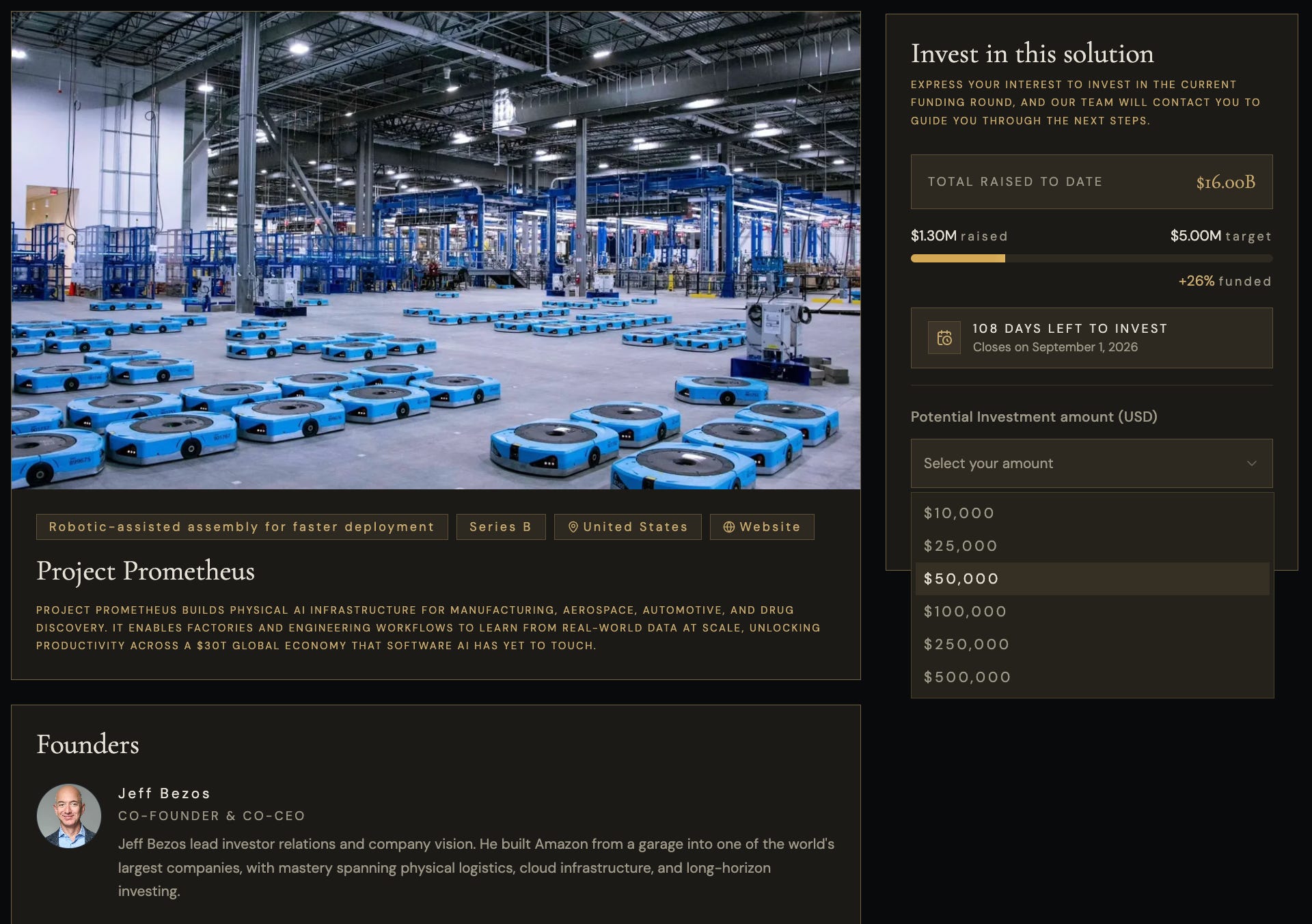
Here is what you need to know:
Minimum checks range from $10K to $500K depending on the deal and allocation availability
Submit your intended investment amount to receive the full memo, due diligence materials, and allocation details
Access is limited to qualified investors and you will need to answer a few questions for KYC checks. Not every requests are being approved.
This is the largest Physical AI round in history. $16 billion raised in six months. JPMorgan, BlackRock, and sovereign wealth funds are already on the cap table. The $30 trillion manufacturing economy has no AI infrastructure layer. Bezos is building it.
We do not send deals like this often. When we do, the window is short.
Request access here: https://wetheatlas.com/solutions/6a057ec6cd40eafa9503ca6c
VIII. THE QUIET RENAISSANCE VIEW
Foundation presenting on our stage before their Pentagon deal closed. GrayMatter showcasing their product at our family offices summit. Prometheus raising the largest Physical AI round in history while most investors were still debating whether Sam Altman is cool or not.
This is what the Quiet Renaissance looks like: the builders and the capital finding each other before the headlines catch up.
The families writing checks into this space are not betting on quarterly returns. They are betting on structural transformation: the automation of physical labor at civilizational scale.
The window is 10 days.
Fight the Good Fight.
— Djoann Fal Founding Partner, Atlas Coalition, WeTheAtlas, Atlas Capital.
 | A guest post by
|