Did Climate Change Slow Down Potential Past Industrial Revolutions? And Will It Stop Our AI Upcoming One? 🤖
Tolkien, George R. Martin... Their pre-industrial fantasies. And Will Climate change Stop Our Upcoming AI Industrial Revolution?
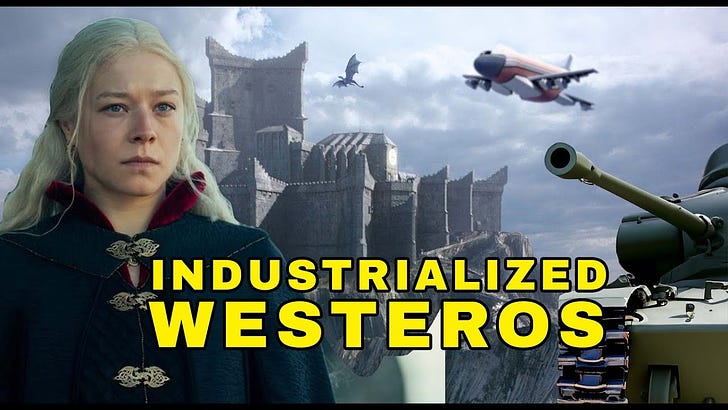
Last week, Amazon Prime Video released its Rings of Power Season 2 trailer. (Something I will probably never watch after being disappointed by the last season). But something came up while talking with my best friends about this which I think will interest you: Did you ever ask yourself, why did none of our favorite fantasy worlds reach the Industrial Revolution?
Furthermore, looking at the past thousands of years of human history, did extreme weather events contribute to push back potential early industrial revolutions that could have occurred?
The Industrializations Problems of Fantastic Universes
Okay. So after 3 years of looking at the topic of climate technology investment, reviewing nearly 1,000+ solutions per year with our small team at Atlas Capital, I think I can say that I have seen it all… and that I’m starting to be pretty bored of hearing /seeing the same thing.
“We are fu****”, “Record year of hottest temperatures”, “We need to act now”… Again, again and again.
To the point that it does not touch my emotions as much as a few years ago. In fact, sometimes I even feel irritated to hear the same problems and often the same (useless) solutions.
But what if I had it all wrong? What if I was looking at this situation from the wrong angle?
Spoiler alert:
“Winter is coming” looks very much like our earth’s Little Ice Age (1300-1850 CE).
What if to understand what really mattered, I had to step back out of the real world and analyze our social constructs such as the shared reality we imagined in Game Of Thrones actually influenced our fears and responsive actions?
There is a recurring problem in every fantastic universe we like to entertain ourselves with:
A big bad thing is threatening peace and impeaching our capitalistic civilization to thrive.
We have to rally and fight this big bad thing first before having the chance to enjoy peace (and maybe finally industrialize).
This week, Rie and I did a deep dive into the freezing winters of Game of Thrones and how it did, (or did not) affect its potential industrial development.
🍿 Have fun watching 🍿 :
So, we've now seen how a big bad thing (like climate change) has affected the environments in our fantasy worlds. But have you ever wondered if climate change played a role in pushing back past potential industrial revolutions?
Ancient (postponed) Industrial Revolutions. ⚙️
Everyone knows that the first Industrial Revolution dates to the late 18th century and brought us steam engines, railways, and factories. And that the second one in the late 19th century introduced electricity, steel, and oil. More recently, the third, in the late 20th century, brought computers and the internet. And yes, each of these periods of peace and friendly climate transformed our societies in amazing ways. Now here are some stunning facts that ONLY FEW KNOWS ABOUT:
The Roman Empire: The Roman Empire could have reached an industrial revolution if not stopped by climate change. Yup, Rome and the entire Mediterranean region actually experienced significant economic and technological advancements, particularly during the Pax Romana (27 BCE - 180 CE). Innovations in engineering, agriculture, and transportation could have led to an early form of industrial revolution, including guns and flying machines. However, the Late Antique Little Ice Age (c. 300-700 CE) brought cooler temperatures and increased variability in climate, contributing to the agricultural decline, economic instability, and ultimately, the weakening of the empire.
The Medieval Warm Period: During the Medieval Warm Period (c. 950-1250 CE), Europe experienced warmer temperatures, which led to agricultural expansion and economic growth.
In fact, positive climate change did play a significant role in the Viking Age, which succeeded the Late Antique Little Ice Age. The period of Viking expansion coincided with what is known as the Medieval Warm Period. During this time, the climate in the North Atlantic region was relatively mild, which may have contributed to the Vikings' ability to travel and settle in new areas. Milder weather would have made sea voyages less perilous and allowed for better agricultural conditions in the areas they colonized, such as Greenland and parts of North America.
Most importantly, this period saw technological advancements in agriculture, such as the heavy plow and the three-field system, which massively increased productivity and the number of populations medieval cities could feed.
The Little Ice Age:
However, the subsequent Little Ice Age (c. 1300-1850 CE) brought colder temperatures and harsher winters, leading to crop failures, famines, and social unrest.
Just so you understand this: some regions in Europe during that time experienced a full year without a summer.
Basically, during the Little Ice Age, a -1 to 5 degree Celsius in winter dragged back civilization to its darkest moments for several hundreds of years. These climatic conditions hindered the potential for an earlier industrial revolution by causing economic disruptions and slowing technological progress. Source: What was the Little Ice Age[…] Why Do We Care? Columbia Climate School
So now that we learned how previous potential industrial revolutions might have been pushed back due to climate change, most importantly, will it affect our future one?
The promised age of abundance. 🌱
Today, you open YouTube, and the first thing you’ll have is a video recommended to you on how AI is going to reach AGI and free men from labor forever. Or maybe another video about why NVIDIA stock is so high as they are creating a new generation of AI agents. Another one on how biotechnology is going to make us immortal. Or else a video on why Teslas are actually going to be able to self-drive themselves and make you money why you sleep: Welcome to the promised land. The age of abundance is near (or at least it feels like it should be).
Seems like we are almost there: On June 18, NVIDIA’s market cap was hitting a staggering $3.34 trillion, eclipsing Microsoft (MSFT) to become the world's most valuable company.
Well, at least that is what we are hoping for. Unlimited Oil, unlimited nuclear power, solar and wind energy, unlimited robots to serve us, farming food, carrying stuff.
Well, what if this upcoming industrial revolution was actually “Cancelled”?
Something I learned last year working with the top 5 largest maritime logistic companies’s family office in the world (read my full case study here) is that our current global energy and supply chain is not very stable and it’s resilience to environmental changes is pretty weak.
And today in fact I doubt that it could survive a new Little Ice Age.
Starting in the late 2000s and peaking in 2023, the surge in piracy off the coast of Somalia and in the Gulf of Aden forced the rerouting of ships around the Cape of Good Hope, elongating to 8 days the arrival of goods and slowing down the entire global agricultural supply chain.
This is just 1 example of how a couple hundred Yemen kids could jeopardize our global food stability. Now imagine what would happen if if our supply chain suddenly had to face a -15 degree Celsius in winter and a +15 degree Celcius in summer?
Well, that just happened this year. Not +15 degrees celcius but +17 degrees.
Thanks god, today’s vickings are too busy to invade anyone, watching Netflix or playing World Of Warcraft so we should be fine on that front.
But will our AI datacenters able to withstand heat increases of +17 degrees?
Conclusion: Adaptation Opportunities in Adversity ⚔️
So, looping back to our initial thoughts, it is not really about “caring about climate change”, but more about “Can our civilization energy supply chain resist to heatwaves and extreme weather (enough to power AI and robots to feed us and do our work)”.
On this front, I believe climate change will drive innovation to make such critical energy and food systems more resilient. This is kind of our adaptation investment thesis with Atlas Capital.
Just like past revolutions were about solving problems and making life better, this one can be about creating sustainable technologies. Large scale nuclear energy adoption, buildings retrofitting, heatwave resilient supply chains, and climate-proof grids are all part of this new wave of innovation.
Climate investments — Check out some examples of our team’s recent researches on the buildings adaptation market:
My Stance moving forward
This is what I believe in Adaptation.
We need to ask ourselves how we can innovate in ways that not only protect our planet:
“How can we innovate in ways that can help us be protected from the threatening climate of our planet”
It’s not just about slowing down or stopping climate change — this is too late; it’s about finding smarter, greener solutions to survive and thrive amidst extreme weather.
That is my nonorthodox stance on climate.
Join the Conversation 💬
What do you think? Can we overcome the challenges of climate change and continue to innovate? I’d love to hear your thoughts.
Stay Tuned
In our upcoming episodes, we will explore how different sectors are adapting to these challenges and what technologies are leading the way.
Thank you for reading, and I hope you find this intellectual exploration as exciting as I do!


